
Our Approach
The Instituto Mulungu follows a path that differs fundamentally from conventional large-scale replanting.
At Sítio São Pedro, restoration is guided by careful observation and local adaptation. The land is divided into small cells, each managed according to its specific ecological conditions. The nursery develops organically, gradually incorporating new native species and expanding genetic diversity. Practices such as selective clearing and the planting of fruit-bearing species encourage natural regeneration, the return of wildlife, and the creation of ecological corridors.
Every action is planned, tested, and evaluated, based on a detailed inventory of the initial conditions—because restoring a forest is a process that requires precision, patience, and attentive listening to the land.
Read more
Perhaps the best way to define what we do is by describing what we do not do: we do not follow conventional large-scale replanting models.
In practice, much of what is commonly called ecological restoration takes place over just a few days, following a standardized formula: seedlings from different successional stages are planted simultaneously, based on the assumption that pioneer species will grow faster and provide the shade required by secondary and climax species to develop.
This approach has a clear advantage: it allows large areas to be covered relatively quickly. But it also raises a fundamental question: what is the actual success rate? While it is true that pioneer species grow faster than climax species, which do not tolerate direct sunlight, such as the jequitibá-rosa, for example, is this growth fast enough to ensure the survival of more sensitive seedlings?
We do not have a definitive answer to that question, and in any case, this is not the path we have chosen.
From our perspective—and this is precisely what we are implementing at Sítio São Pedro—meaningful results are not possible without close attention to detail. For this reason, large areas have been divided into small cells, each hosting different ecosystems. One example is Cell 1, which covers only about 1,500 m² yet contains four distinct ecological situations.
This cellular division allows us to work with focus, adapting planting strategies to each specific condition and enabling close monitoring of results. This is what we call our “laboratory” approach.
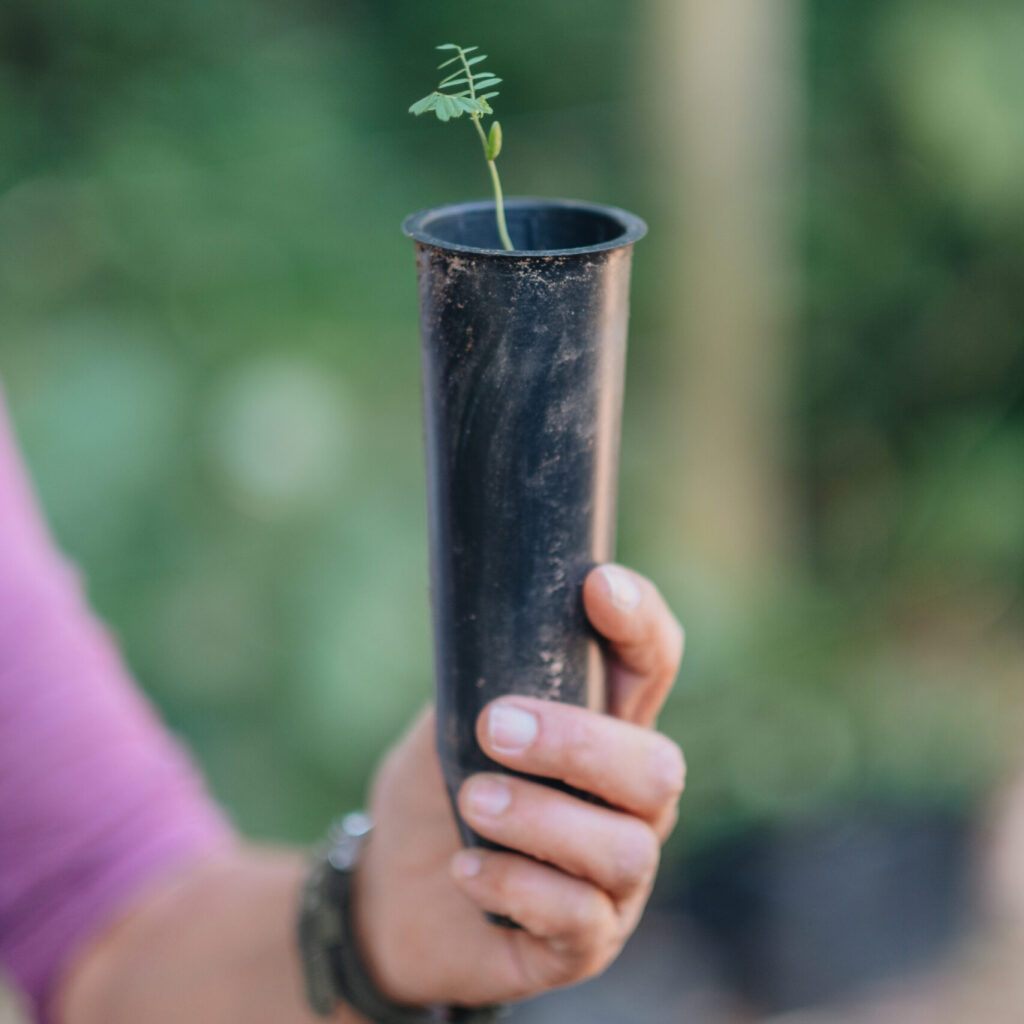
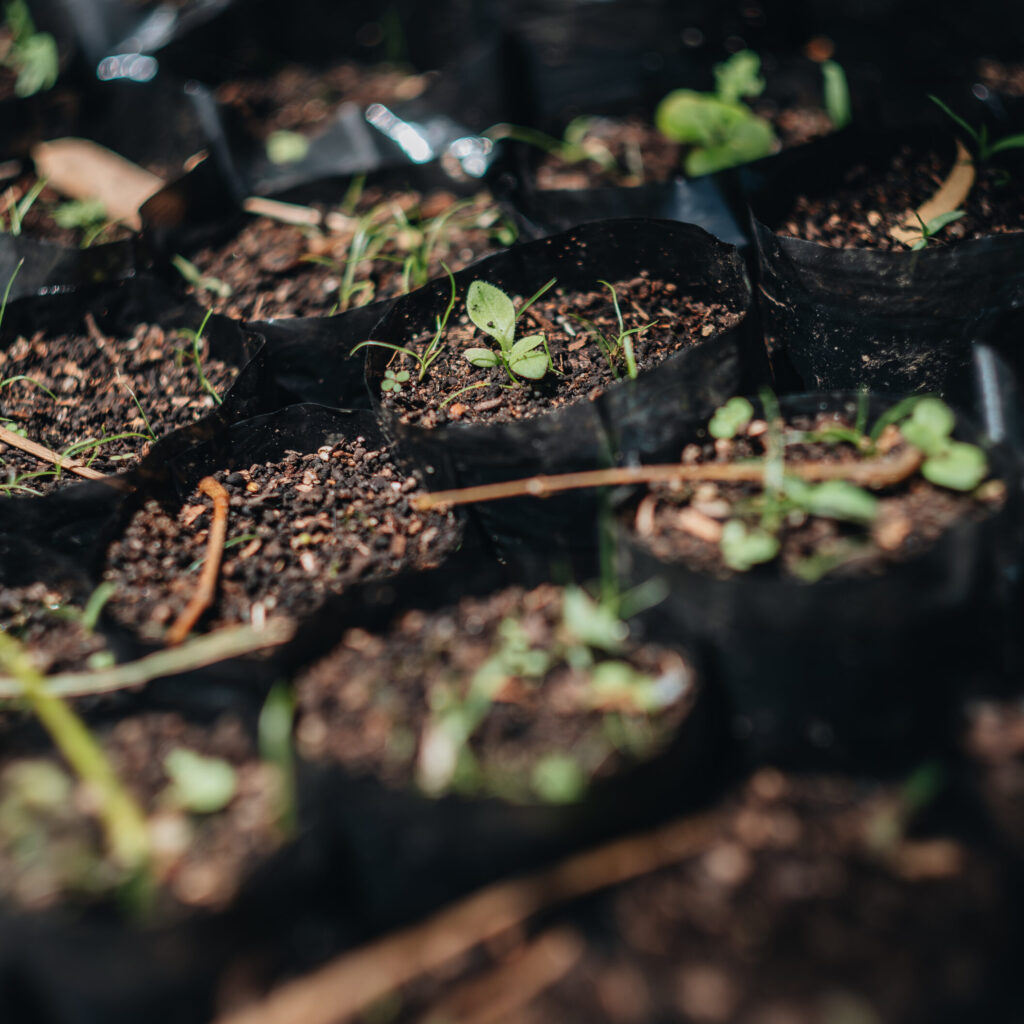
At the same time, we continue to cultivate in our nursery the same species introduced in 2024, while adding many new ones in order to promote enrichment, including genetic diversity. The nursery grows organically, evolving in step with our observations and learning.
Species selection itself is a central concern. In 2025, we began expeditions into nearby forest remnants with the aim of identifying species and understanding how different plants respond to environmental stress and disturbance cycles.
Another essential practice in supporting the ecosystem’s own restorative efforts is selective clearing. On the one hand, this helps us control the invasion of highly aggressive exotic vegetation, particularly in former pasture areas. On the other, it strengthens spontaneous regeneration processes within the ecosystem, creating a foundation upon which we can introduce diversity through targeted planting.
Our emphasis on planting fruit-bearing species—such as pitanga, jabuticaba, grumixama, gravatá, and jerivá—along forest edges and within vegetation islands in pastures serves not only to nourish birdlife, but also to create aerial ecological corridors, expanding seed dispersal pathways.
Thus, rather than adopting a standardized, large-scale restoration model, we have chosen a fully artisanal approach, grounded in observation, understanding, and continuous questioning. This allows us to maintain full control over which species are introduced into each ecosystem, and to assess and adjust every action so that outcomes align with our expectations.
Finally, a crucial element of any ecological restoration project is the survey and inventory of the starting point. In our view, this is perhaps the most important information of all: it is what allows us to measure results and critically evaluate the paths we choose to follow.